Sanbornton's Posted ADU Rules Are Older Than the Law That Governs Them
October 22, 2026
October 22, 2026
Open Sanbornton's zoning ordinance on the town website and you get a file labeled "2026 EDITION." Article 4.X, the accessory dwelling unit section, carries a heading dated March 2021. It says a stand-alone ADU lot can "in no case" be smaller than two acres. It caps the unit at 850 square feet. It says both homes must share "a single driveway entrance onto a public or private road."
Picture a buyer comparing Lakes Region towns who wants room for a parent or a rental unit. That buyer reads those three lines and crosses off every Sanbornton listing on an acre and a half. Under current New Hampshire law, most of those properties should stay on the list.
The state rewrote the ADU statute in 2025 and changed it again in August 2026. Sanbornton's Planning Board is now moving its own text to match. The posted ordinance describes a set of limits that state law has largely replaced. On many older Sanbornton properties, the room for a second unit already exists. The town's 2027 vote would mostly put that in writing.
A buyer researching an ADU in Sanbornton today could read three sources and get three answers. Here is how they line up on the points that matter most in a purchase decision.
| Question | Posted town ordinance, Article 4.X | State law, RSA 674:72 and 674:73 | Amendment recommended Oct. 15, 2026 |
|---|---|---|---|
| Minimum lot for a stand-alone ADU | Two acres, plus district lot size, frontage and setbacks | No extra lot-size, frontage or setback controls beyond what a single-family home needs | Minimum lot size eliminated |
| Maximum size | 850 sq ft, two bedrooms max | 950 sq ft unless the town allows more; a town can't set a cap below 750 sq ft | 950 sq ft |
| Driveway | Both units on a single driveway entrance | No shared-driveway mandate in the statute | Shared-driveway requirement removed |
| Owner occupancy | Owner lives in either unit | Town may require it but can't specify which unit | No change recorded |
The text of RSA 674:72 is direct. One ADU, "which may be either attached or detached, shall be allowed as a matter of right," and the municipality shall allow it "without additional requirements for lot size" and the other dimensional controls beyond what a single-family home would face. The companion section, RSA 674:73, now opens with "A municipality shall permit one detached accessory dwelling unit." Those words came from HB 577, which took effect July 1, 2025.
The best evidence of the gap is the board's own discussion. At the October 15 public hearing at Old Town Hall, the minutes record the Planning Board's explanation that the two-acre requirement applied only to stand-alone ADUs. They also record the board's statement that "according to State statute, we cannot limit ADU in a non-conforming lot as long as the setback is met."
In other words, the board treated the two-acre line as something state law had already limited. The amendment cleans up the text. It does not create a new right.
The same reading applies to the 850-square-foot cap. Under the statute, 950 square feet is the default unless a town authorizes more, and no town can set its cap below 750. Sanbornton's 850 sits above that floor, so the town is choosing a number within the range the state allows. The amendment moves it to the state default.
The minutes show the board also made changes at the hearing itself. Clause 3g said there could be no exterior alteration or enlargement of the main house that "will alter its character or appearance as a single-family residence." The board voted 5-0-0 to strike it. Members also confirmed that "manufactured homes" would come off the list in item 3j. They then recommended the amendment to the selectmen for the town warrant, again 5-0-0.
Most of the attention in Sanbornton has gone to lot size. For older farmhouse and homestead properties, though, the bigger shift came this summer in a different bill.
HB 1079 was signed July 2, 2026, became Chapter 210, and took effect August 31, 2026. It added paragraph XI to RSA 674:72. Under XI, a municipality "shall allow accessory dwelling units to be converted from existing structures, including but not limited to detached garages, regardless of whether such structures violate current dimensional requirements for setbacks or lot coverage."
That cuts against one of the usual objections to converting an outbuilding on an older New England property. Barns and carriage sheds built close to the road or the lot line often predate modern setbacks. The new paragraph defines an "existing structure" as one that stood on or before July 1, 2025.
A town may ask the applicant to show that the structure is either a preexisting nonconforming structure or one that got a prior zoning approval or exemption. The statute also says converting it to an ADU "shall not constitute a change of use" that would cost the building its nonconforming status.
The same act added paragraph XII. It says a municipality "shall not deny the establishment of a separate electrical panel and separate electrical service to the accessory dwelling unit."
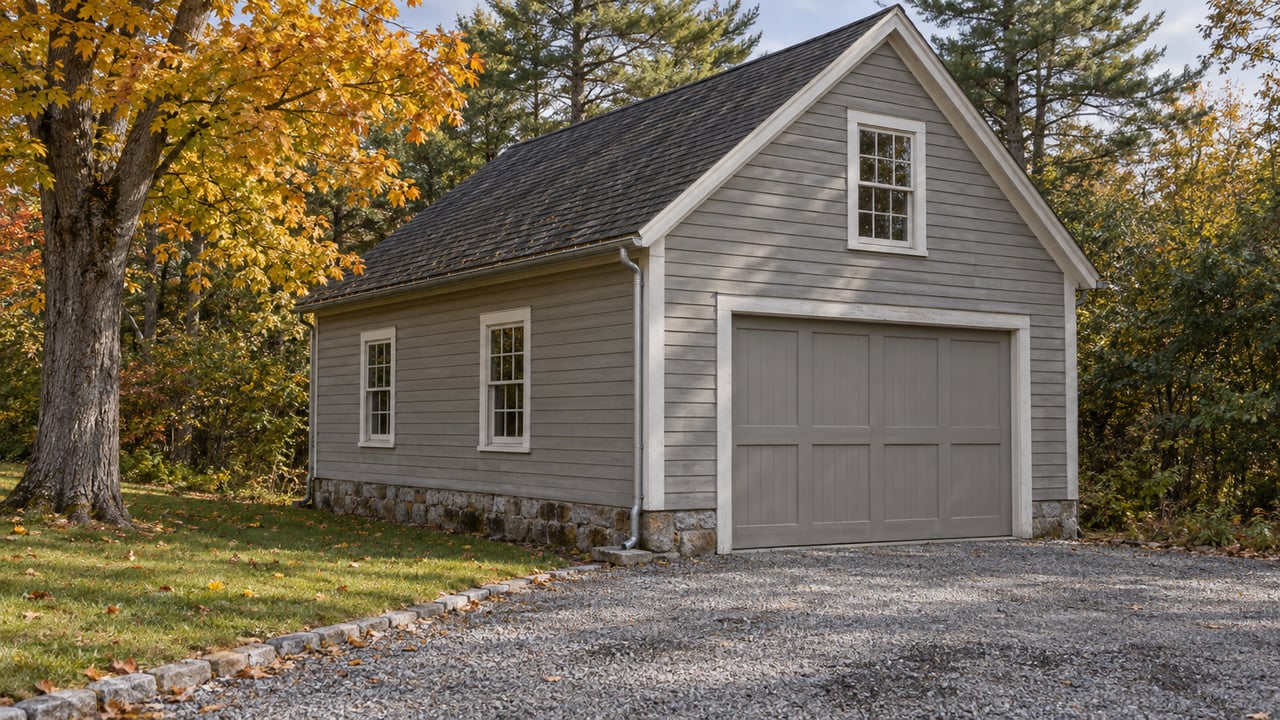
Sanbornton's posted ordinance already allowed a detached ADU that "is part of a garage, barn, or other such structure" in every zoning district. Chapter 210 adds protection for the older, oddly placed outbuilding that might otherwise have been blocked by setbacks. Those buildings are common on Sanbornton's antique properties.
State law sets the outer limits. It leaves several decisions to the town, and those are the ones that tend to come up during a purchase.
On an older rural lot, the septic item usually matters most. Under the statute, a newly approved system has to be installed if the existing one never received construction and operating approval under current or predecessor rules, or if it fails or needs repair or replacement. Everything here is general information, not legal advice. Before you rely on any of it for a specific property, confirm with the Town of Sanbornton and a qualified attorney or septic designer.
In September 2026, Belknap County had 96 closed single-family sales, a median sale price of $555,000, and a median of 39 days on market, according to the NH REALTORS® local market update current as of October 5, 2026. The New Hampshire Bulletin reported a July 2026 county median of $615,000. That spread shows how much a countywide median can move from month to month. It is not a Sanbornton-specific price.
Fewer than a hundred sales in a month across an entire county means a thin pool. A buyer who rules out every Sanbornton property under two acres based on the posted ordinance shrinks that pool more than state law requires. The same logic applies to a seller. An older property with a sound barn or detached garage may have uses that a listing written from the town text would never mention.
The town's longer-term planning points the same direction. On September 3, 2026, the Planning Board approved an updated Housing Chapter of the Master Plan. It recommends reviewing ADUs along with workforce housing, senior and cluster housing, short-term rentals, and duplex and multifamily rules. At an August 6 workshop, the board heard that ADUs are one piece of a housing plan and that ADUs alone may not provide an adequate tax-to-service ratio. ADU drafts appeared on Planning Board agendas in May, June and July before the October hearing.
When do Sanbornton voters decide the amendment? The Planning Board recommended it to the selectmen for the town warrant. The New Hampshire Secretary of State's 2026–2027 political calendar lists town elections for March 9, 2027. In March 2026, Sanbornton's ballot carried two zoning-amendment questions.
Does the occupant of the ADU have to be a family member? No. RSA 674:72 VIII says a municipality "shall not require a familial relationship" between the occupants of the two units. Paragraph IX says a town can't limit an ADU to one bedroom.
Can the ADU be sold off separately as a condo? The statute prohibits selling an ADU separately from the main home as a condominium unless the municipality allows it.
Is anything else from the October 15 meeting headed to the warrant? Yes. The board also recommended combining the two home-occupation levels into one ordinance. The minutes record that more than ten vehicle visits a day would trigger site-plan review.
If you're looking at a Sanbornton farmhouse with a barn out back, or deciding how to describe one you plan to sell, we're glad to walk through that property's outbuildings, septic history and lot with you before you commit. Holistic Homes Group works with antique and homestead properties across the Lakes Region. Schedule your free 30-minute consultation.
Stay up to date on the latest real estate trends.
Our team offers personalized support for buyers and sellers who value lifestyle, community, and connection. Wherever you're headed, we’ll help you find the place that feels just right.